

On this page
The Master Builder Reborn
My inspiration for work has always been my dad. Born into a rural village in Kefalonia, Greece, he spent his childhood working in the gardens and rising at 4AM to sell vegetables to surrounding villages on the mountain before others did. It was this enterprising spirit that brought him to Canada when he was 17 years old, with less than $17 in his pocket and in search of a brighter future. He became an entrepreneur across many domains including food, entertainment, hospitality, and real estate development before eventually settling on construction.
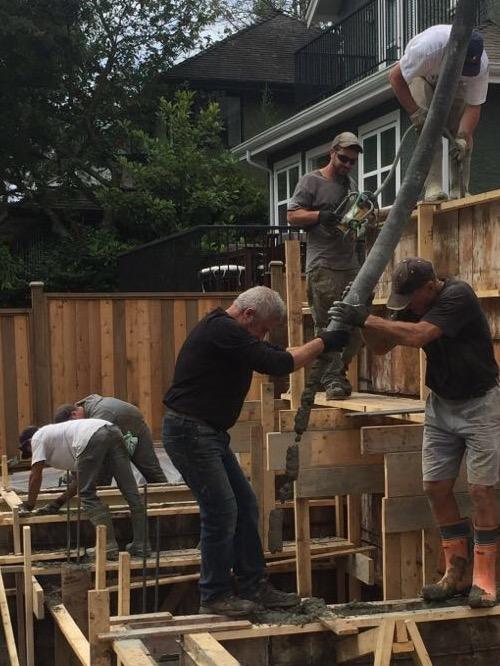
I grew up watching him work, building dozens of homes in Canada and Greece. Naturally and as any immigrant kid would appreciate, I was working on site with him long before I should have. What struck me was always the totality of his involvement. In the same hour I’d see him hand-sketch a detail for the roofer, negotiate loan terms with the bank, argue with the owner, configure the HVAC settings, then mix and pour concrete for the sidewalk. I’ve even seen him wire an electrical panel or two (the inspector didn’t come by too often in the village). He was a true master builder.
For the uninitiated, the master builder is the most romantic idea in all of construction. It refers to an individual who can bring a building from conception through to completion - combining all the skill of architect, engineer, construction manager, and craftsperson. Michelangelo famously designed and but also assumed enormous construction responsibility for St. Peter’s Basilica. More recently, Antoni Gaudi did the same with the Sagrada Familia.
Master builders for this scale of project, however, have largely been lost to the ages. As buildings became more complex and efficiency became paramount, the master builder gave way to specialists. Architecture separated from engineering; engineering divided into structural, mechanical, electrical, and plumbing; and those disciplines subdivided again into dozens of specialties. When I was a MEP Manager on hospital design-build projects, I’d need to coordinate between two-dozen different design firms and subcontractors.
For all the benefits of this specialization, there are drawbacks. It is impossible for any one person to contain the full context of large construction project within their mind. So this creates the need for countless hours of coordination sessions, meetings, documentation, planning, validation. Each contributor has become extremely adept at their specialized craft. The greatest risk increasingly lives not within each discipline, but between them. At Buildcheck we have reviewed over 150,000 drawings to date and flagged over 115,000 comments. Even the best projects carry significant risks. 2/3 have significant life-safety comments including underrated walls, egress issues, or missing fire dampers. This goes beyond just saving time and money, it prevents real danger.
Our ultimate vision, however, is far beyond error identification: it is to enable the next generation of master builders. We’ve trained computer vision models that can understand drawings, parse thousands of pages of project documentation, construct a knowledge graph to represent the relationship between every discrete component, and deploy agents to perform work on top of it all. This lies outside the capability of off-the-shelf models. It was formed with years of specialized data preparation, custom model development, pipeline orchestration, multiple patents, and Stanford-trained researchers. All of this is necessary to perform design reviews, and it’s imperative for what is to follow. 20% of the $13T construction industry is comprised of “soft costs” outside the hard materials and labor. All of that work requires a deep understanding of the project.
We see a near future where a construction manager can run a hospital project from conceptual through completion with complete command. AI will translate an owner’s ambitions into requirements and programs, continuously coordinate the design, estimate cost and schedule, plan procurement and construction, and orchestrate execution in the field. It will understand every drawing, specification, decision, constraint, and component and how a change to one ripples through all the others. For the first time in generations, we can recreate the breadth of the master builder — not by asking one person to know everything, but by giving them a tool that does.
Crucially, judgment remains in the hands of experts. AI should not make the final call on engineering, safety, cost, or design. Its role is to give those experts something the complexity of modern construction has taken away: the ability to see the whole project at once. The expert still decides what to build and how to build it; AI gives them the reach to act like a master builder again. That is our mission at Buildcheck, and today we’re announcing our $12M Series A financing to accelerate it.
Today, more than 110 paying customers including DPR Construction, EllisDon, Power Construction, IMC Construction and EMJ Construction use Buildcheck across data centers, healthcare, commercial, and residential projects. What began as a way to automate discrete drawing checks is quickly becoming a comprehensive design review and collaboration platform for entire project teams. Buildcheck can turn a contractor’s own QA/QC playbooks into custom AI review agents, isolate meaningful changes between drawing revisions, identify code issues, and surface value-engineering opportunities. And because construction leaves little room for hallucination, our technology is paired with experienced industry experts who validate outputs, combining the speed and breadth of AI with the judgment of people who have actually built things.
Now we’re building the team to take that much further. We’re bringing together cutting-edge AI engineering and deep construction expertise, and looking for engineers, salespeople, researchers, and builders who want their work to manifest in the physical world — in hospitals, data centers, housing, and infrastructure. Few industries offer the opportunity to reshape how trillions of dollars of physical infrastructure gets created. For people who want to spend the next decade building toward something consequential, I can think of few problems more worthwhile.
This year, my wife and I were blessed with the arrival of our daughter. If I’m lucky, maybe one day she’ll choose to join the construction industry we all know and love. But hers will be a different industry. She may never know a world where delivering a project on time and on budget feels as difficult as it does today. And in some ways, her experience might look more like her grandfather’s than mine: able to see the whole project, make decisions across disciplines, and take responsibility from beginning to end.
Except instead of building houses, she’ll be building skyscrapers.
